AI’s Resource Demand is Scaling Faster Than Buildout
Artificial intelligence runs on physical inputs: data centers, semiconductors, fiber networks. As adoption rates rise, so does capital expenditure toward resources necessary to scale the technology further. For advisors mapping how macro themes translate into client portfolios, the question is not whether AI will keep growing, but who finances the infrastructure that makes that growth possible.
Data Center Construction is Surging, But Capacity Remains Scarce
Data center construction has climbed steadily, reaching a $59.31 billion annual pace in May 2026 as builders pull forward capacity ahead of tenant demand.
Private Data Center Construction Spending
Seasonally adjusted annual rate in U.S. dollars, selected months, 2025 to 2026.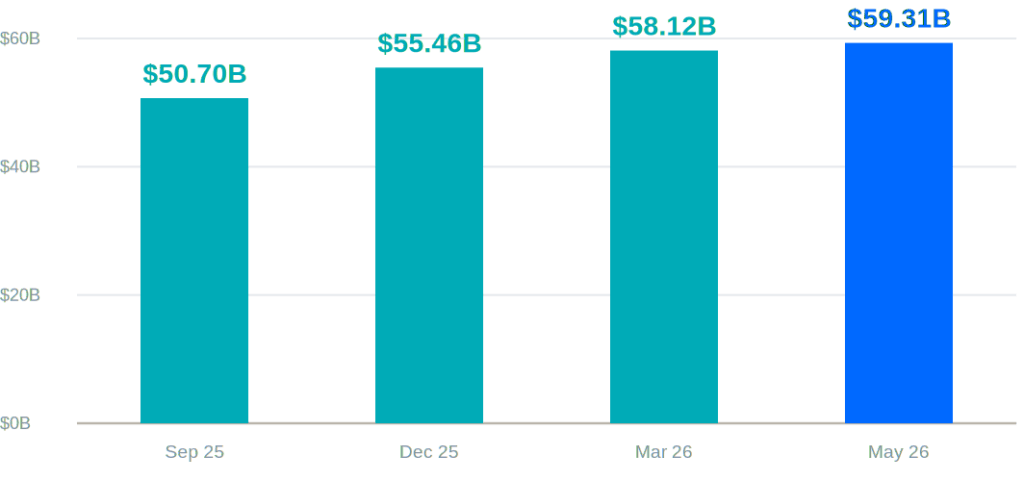
Source: U.S. Census Bureau private construction of data centers (monthly SAAR), via Board of Governors FEDS Notes accessible data, retrieved October 9, 2026.
U.S. data center construction starts reached $84.1 billion through July 2026, nearly three times the prior-year pace and roughly one-quarter of all nonresidential building starts. Power infrastructure starts have risen in tandem, growing from about $9 billion in 2021 to $37 billion in 2025.¹
Yet new capacity is being absorbed as quickly as it can be built. North American data center vacancy has held at 1% for a third consecutive year despite unprecedented construction,² and across the Americas, 91.7% of the 37.7 gigawatts under construction was precommitted prior to delivery as of H1 2026.³
Investment-grade, hyperscaler-backed projects command loan-to-cost levels of up to roughly 85%, and securitized data center volume across SASB, CMBS, and ABS channels reached $17 billion in the first half of 2026, up 29% year over year.²
Higher AI Adoption Rates Mean Increasing Capital Expenditure
A Federal Reserve FEDS Note published in April 2026 estimates based on survey data from the U.S. Census Bureau that as of year-end 2025, roughly 18% of U.S. firms had used AI for business functions. The survey’s outlook for AI adoption indicated even further expansion, with about 20% of surveyed firms reporting they expected to use AI in the first six months of 2026. This figure more than doubles the expectations for the same period in the year prior: at the beginning of 2025, 9% of surveyed firms expressed plans to implement AI in their business within six months, and the adoption rate that transpired by June was in line with that projection.⁴
That reality is already shaping plans for corporate investment in AI. Amazon raised its capital expenditure outlook to approximately $220 billion for 2026 and stated it would still lack capacity to meet the full demand for the year.⁵ Alphabet lifted full-year guidance to a $195 billion to $205 billion range after spending $44.9 billion in the second quarter alone,⁶ and Microsoft described calendar 2026 capital spending of roughly $175 billion.⁷
Meanwhile, public capital remains fickle, with investors rotating out of technology holdings even as hyperscalers reiterate multi-year build plans. Though we are still early in the AI expansion cycle, the underlying trend points to a high capital demand that public investments alone may not be able to meet.
Financing a Long-Duration Build at Higher Interest Rates
The FOMC move to raise short-term interest rates in September further complicates access to capital for AI expansion. Prediction markets have forecast another Fed hike in 2026, followed by two more in the new year, which would bring short-term rates to a target range of 4.50 - 4.75% in 2027.⁸ Though the course for monetary policy remains to be seen, hyperscalers seeking capital are likely anticipating increased borrowing costs as a higher interest rate environment begins to take shape.
The Role of Private Infrastructure
The most durable part of the AI opportunity may sit one layer below the headline technology names, in the power generation, data center, and transmission assets that make compute possible. For most individual investors, we believe private infrastructure is the better way to own that layer than publicly traded infrastructure equities.
Listed infrastructure stocks offer daily liquidity, but that liquidity has a cost. Their prices move with the broader equity market, so investors absorb market beta and sentiment-driven volatility that often has little to do with the assets’ underlying cash flows. Many listed names are also diversified utilities or conglomerates, where exposure to AI-driven load growth is diluted across legacy businesses. An investor who already holds large technology positions may be adding more of the same risk rather than diversifying it.
Private infrastructure lets investors own the assets themselves rather than a market-priced claim on them. Returns are driven mainly by contracted or regulated revenue, such as long-term power purchase agreements, co-location leases, and transmission upgrades, rather than by daily trading. Private managers can also reach the parts of the market where much of the value is being created: greenfield development, sale-leasebacks with hyperscalers and utilities, and joint ventures that are rarely available in public form. Structures such as interval funds now make this institutional-style exposure available to a much broader set of investors, with periodic liquidity matched to the long-dated nature of the assets.
What We're Watching
- FOMC December meeting. Another interest rate increase could raise financing costs for infrastructure pipelines.
- Q3 GDP advance estimate. The release will show whether AI-related investment is still contributing to growth.
- October payrolls. Labor data may test whether adoption remains augmentation-heavy as hiring slows.
- Census construction releases. Monthly figures will indicate whether data center spending has sustained its 2026 pace.