

Does the Structure Matter? Understanding Interval Funds and BDCs
Recent headlines have put a spotlight on two prevalent access vehicles for private market investing, Business Development Companies (BDCs) and Interval Funds.
Both structures have seen considerable growth over the last decade and have been an integral part of the adoption of private market investments by individual investors. The use case for each structure is similar. They both offer limited liquidity, which allows the manager to execute a long-term strategy while providing the investor with some access to capital.
In practice, differences in the structures can lead to very different outcomes for individual investors.
An Institutional Asset Class Goes Mainstream
While the asset class has existed for decades, private credit has grown considerably in recent years. Direct lending, one of the dominant strategies, refers to floating rate, senior secured loans that typically carry covenants. The industry manages more than $1.2 trillion in outstanding loan assets globally, up from just $100 billion in 2010.1 This primarily reflects growing participation from non-bank lenders, as bank consolidation and increased bank regulatory burdens have resulted in banks significantly pulling back from this market, except for the largest deals.
The growth of market share by non-bank lenders reflects a push-pull dynamic between borrowers and lenders. These loans are directly negotiated between private companies who are the borrowers, and the non-bank lenders. Companies value the flexibility, customization, and certainty of execution that direct lenders can usually provide relative to syndicated markets. Direct lending assets generally provide higher yields due to the value companies perceive in these types of loans, the illiquidity premium of the asset, and the complexity of underwriting bespoke transactions.
Institutions have long made private credit part of their portfolios. In recent years, as the resiliency of the asset class has been demonstrated through downturns like the Great Financial Crisis and the global pandemic, the asset class has become more sought after by individual investors. The share of assets under management (AUM) accounted for by individual investors climbed from less than 1% a decade ago to 13%, or $280 billion, today. The past four years seeing most of that growth as many new funds have entered the market.2
Business Development Companies (BDCs)
BDCs have been around for more than forty years. They were created by Congress in 1980 to help middle market private companies secure needed financing and are regulated under the Investment Company Act of 1940.
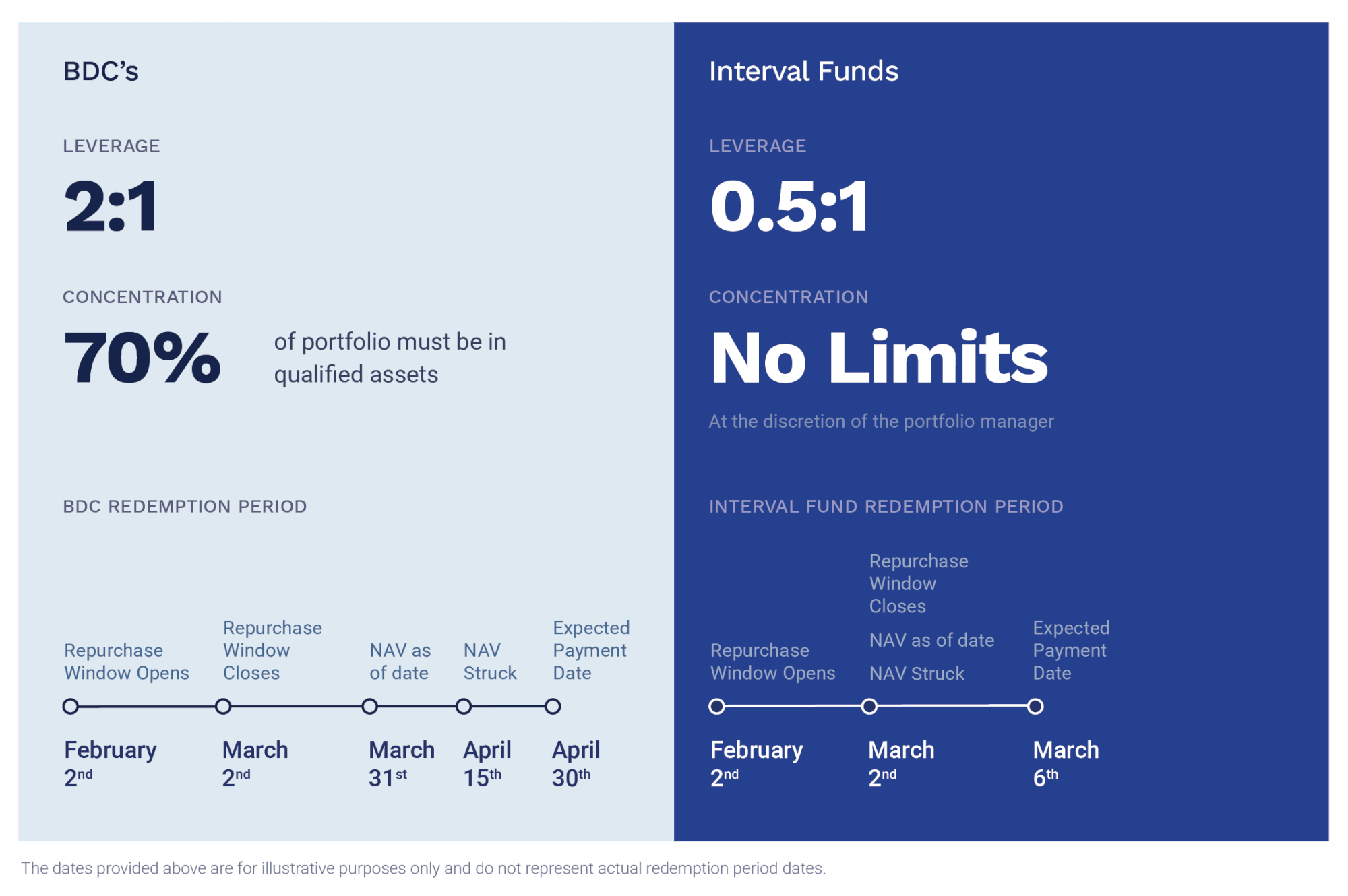
BDCs are required to invest 70% of their assets in the securities of private companies, and they can elect to qualify as a regulated investment company (RIC) for federal income tax purposes, which avoids corporate-level taxation, but requires that they distribute at least 90% of annual investment company taxable income to their shareholders as dividends.
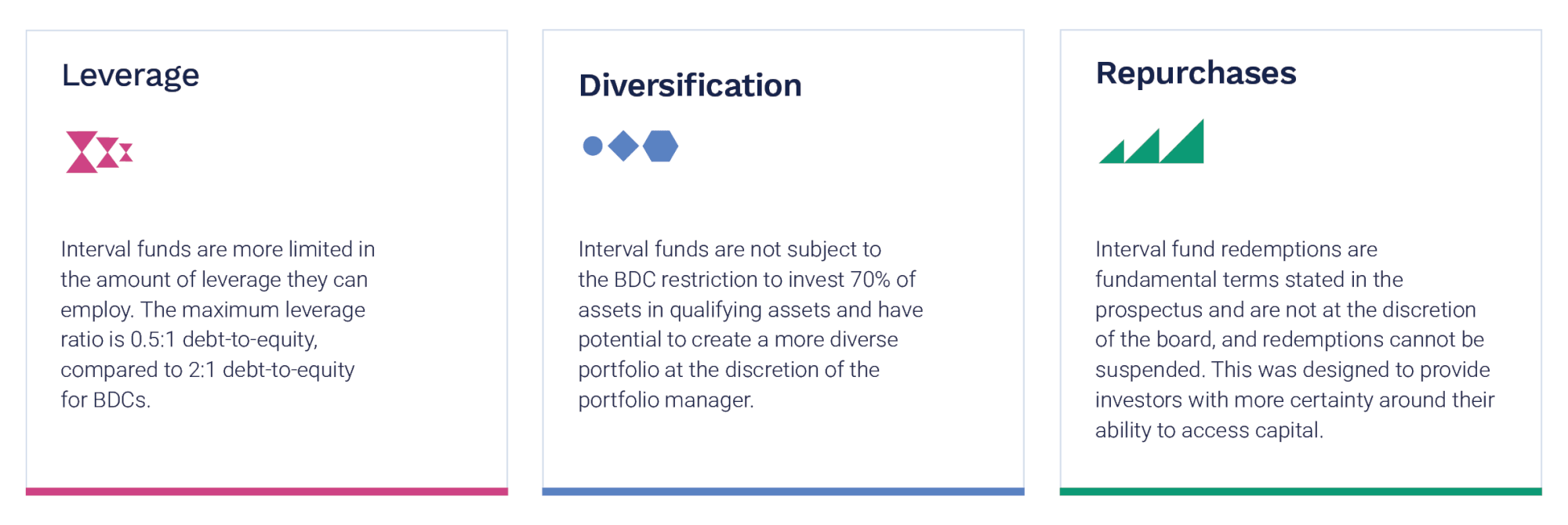
Leverage in BDCs can be up to 2:1 debt-to-equity, meaning they can borrow two dollars for every dollar of equity. While this can provide more flexibility and income potential, it can increase risk.
The structure did not gain traction with managers or investors until the early 2000s, and growth began to scale in tandem with the growth of private credit after the Global Financial Crisis. This has accelerated recently, with assets under management as of the second quarter of 2025 reaching approximately $500 billion, from $120 billion in 2020.3
BDCs can be either public or private, but much of the growth over the past five years has been in perpetual non-traded structures that offer periodic liquidity, typically structured as quarterly share repurchases of up to 5% of their NAV.
These repurchases are generally subject to board discretion, meaning the level of liquidity can vary by period and may be reduced or suspended in certain environments.
Interval Funds
Interval funds were introduced in 1993 to create a structure that bridges the gap in the liquidity spectrum between daily liquidity mutual funds and illiquid private market strategies. They allow access to longer-duration investments while maintaining core investor protections.
The daily repurchase requirements of open-ended mutual funds can, in periods of dislocation, force managers to sell positions prematurely, before they have realized the full value of the investment.
Interval funds provide periodic, limited liquidity, generally offering to repurchase up to 5% of the shares at set intervals, typically quarterly. This provides managers with more predictable liquidity needs, and allows them to hold performing investments for their intended time horizon.
Interval funds are similar to BDCs in terms of taxation, in that they can be structured as RICs, which allows them to avoid double taxation as long as they distribute 90% of income and capital gains to shareholders annually.
However, there are several significant differences where the increased regulation on interval funds can offer additional protections to investors. They are required to publish a daily net asset value (NAV), which provides transparency. The repurchase terms are stated in the prospectus, and redemptions cannot be suspended.
The structure was not widely utilized until the 2010s, when the characteristics of the structure and the alignment it allows between the needs of the manager to execute on a long-term strategy, and the needs of the investor to have some access to capital began to fuel greater adoption in the mainstream retail market.
In 2015 there were less than 10 interval funds in the market. As of the third quarter of 2025, there were 158 funds with almost $146 billion in assets under management.4
A Pioneer’s Perspective
CION was one of the pioneers in launching an interval fund structure with a private market strategy, launching their first fund in 2017. A look at the principles CION adhered to may prove instructive.
A core tenet of CION is the belief that the characteristics of private market assets, including low correlation to the broad markets, portfolio diversification and the potential to lower overall portfolio volatility, should be available to individual investors.
For CION, achieving this required solving several issues. The first was the choice of the structure. CION selected the interval fund structure very deliberately, in the belief that the investor protective features built into the structure could make it more appropriate for an individual investor.
CION believes that manager selection criteria should not be limited to a manager with a strong track record. While performance is an important factor, CION’s criteria also includes selecting a manager that has a clear focus on, and dominance in, the chosen asset class. Looking at the strength of the manager’s platform, the history of their involvement and the relationships they have in the space is equally important.
Another key element is the ability to have a highly diversified strategy with a dynamic asset allocation that can provide value across business cycles and market environments, while mitigating risk.
Interval funds may provide access to a wider range of asset classes than BDCs, depending on the fund’s mandate.
The manager should have a strong understanding of the retail space, be able to manage the product, and have a clear process for managing liquidity. This can include a substantial liquid sleeve, portfolio income, cash, and credit facilities.
A Flexible Structure Designed with Investors in Mind
Interval funds were developed to help individual investors gain access to long-term, private market institutional strategies.
Manager selection is paramount, and individual investors should look for a manager that has proven institutional experience, broad sourcing capabilities, and a rigorous investment underwriting process. Pairing that with a structure that can provide periodic liquidity can help them make these strategies part of a well-constructed portfolio.
Disclosures
- Retail Investors in Private Credit; July 2025; Bank for International Settlements
- Ibid.
- Credit Estimates Provide Transparency into BDCs Investments; December 2025; S&P Global
- XZ Investments. Data as of September 30, 2025.
The information contained herein is intended to be used for educational purposes only and does not constitute an offer to sell or a solicitation to purchase securities. Such offers or solicitations can only be made by means of a prospectus. Prior to making any investment decision, you should read the applicable prospectus carefully and consider the risks, charges, expenses and other important information described therein.
The information is not designed to be taken as advice or a recommendation for any specific investment product, strategy, plan feature. Information contained herein was obtained from third party sources we believe to be reliable; however, this is not to be construed as a guarantee of their accuracy or completeness. Observations and views contained in this piece may change at any time without notice and with no obligation to update.
Investing involves risk, including the possible loss of principal. Past performance does not guarantee future results. No investment is guaranteed, and investment outcomes may vary. These investments are generally intended for investors with a long-term investment horizon who can tolerate limited liquidity, income variability, and the risk of loss. Investors should carefully consider whether these investments are suitable based on their financial situation and investment objectives and should consult their financial professional before investing.
CION Securities, LLC, Member FINRA / SIPC.